Discover Renegade
The idea of presenting yourself to be joined for a lifetime calls for the most authentic expression of your lifetime. Renegade offers Dyeing Services, Custom Design Services, and exciting Collections.
Can a wedding dress be dyed? Many brides wonder if a DIY dye wedding dress project is feasible.
First, ask the right question! Many bridal professionals wrongly think synthetics cannot be dyed. They might not know about our services. But if told no, there's a good reason. Silks and natural fibers take dye well. This is somewhat common knowledge. You may have heard non-silk gowns won't dye. We actually agree for DIY projects. Let's discuss what you can achieve yourself. We will also cover the cost.
What do I need to dye my wedding dress?
Only recently have synthetic dyes become available to crafters. Before Renegade Dye Lab, we experimented. We learned a lot through trial and error.
What did we learn?
We use industry-grade pigments here. For cotton lace or silk gowns, we use reactive dyes. These are chemically similar to craft store dyes. Brides pay $3000+ for a silk gown. They trust our technique. Synthetics need different chemistry. Colors react in varied ways.
How to Dye a Wedding Dress
Equipment is an important part of the equation when we're dyeing synthetics, and it's where more variables come into play. Let me pose a question: How much do you like your kitchen? How much does it cost to power wash your driveway?
First, you need stainless steel tools. Get a gigantic stainless steel pot for your gown. It needs room to move freely. It will never be food safe again. You'll need heat safety gloves. A sturdy stove is also necessary. It must support the pot's weight. We start with about 40 gallons, or 335 pounds. A glasstop stove won't support that. Your stove may be too small for the pot.
Aim for a light color? You must invest hundreds in equipment. You'll never reuse it. Have a tiny, simple dress? Feel confident in your technique? Maybe DIY is for you. I hope you're planning a kitchen reno soon. Luckily, I was during my experiments. I only saw dye-stained counters for a month!
Is it hard to dye a wedding dress?
Allover color? Not necessarily. Your pot must be big. Maintain heat consistently. Use a tool that won't snag. Otherwise, expect spotchy color. Be open-minded about saturation levels. A viral TikTok showed a gal. She tried 5 dresses for allover red. The last one finally worked. I was amused she didn't know why. I'd guess the fiber wasn't polyester.
Can I boil water, then pour it in a tub? No, you need sustained heat. It takes 30 minutes minimum. Some projects require 5+ hours. This might achieve a pale pastel stain. Don't expect better results.
Ombre dip dyeing? Yes, this is possible. It requires some proprietary pre-preparation. You need a rig for the wet gown. Water weight makes it heavy. An artisanal eye is needed for blending. Familiarity with color theory is key. How colors cling, rinse, and look matters. Acid dye vapor isn't pleasant. The craft store bottle fine print mentions it.
We value transparency here. Yes, DIY is technically possible. Our designer started the same way. Is it cost-effective and risk-free? Not really! I had skills in textile chemistry. I also knew bridal customer service and color theory. We spent years testing fabrics. We tested many gowns. This built confidence in our technique. We perfected pre-prep strategy. We refined color buildup with overdyeing. I bought every Goodwill item in Houston. Let us ease your mind.
Check out our pricing estimator.
How can I make my white dress black?
Can it be done? Yes. Can you do it? We wish you the best if you try. Black is the most popular request. It is also the most challenging. About 5% of our black tests fail. We test to ensure desired results. We do this before working on your gown.
Every project's dye formula is custom formulated. For instance, there's no black pigment for synthetics; it's just very concentrated red and blue. Some fabrics push to eggplant. Others hold onto reds, becoming mauve. One in twenty black gown projects may be so stubborn that saturation beyond gray is unattainable.
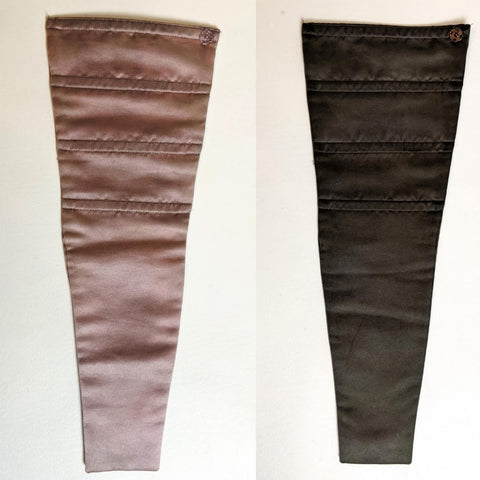
Here's a visual from a bride. She began DIY with her corset panel. It became a warm gray/mauve. We dyed her poly satin gown. We achieved a rich, jet black success!
There are times when we meet our match, every once in awhile, though. This poly crepe would not push past a warm gray/mauve. You can see her lace appliques (synthetic, but a different fiber) were a lovely black. Now, when a dye test fails, we have three choices:
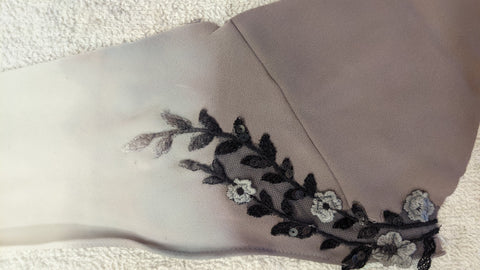
1. Like her, just pivot direction entirely! She ultimately opted for a cantaloupe color! Stunning! A lovely Plan B.
You accept the challenge. You understand parts of your dress will be gray. This is most common. Our portfolio shows many two-tone black dresses. We can show you examples in your consult. Different fibers take color differently. Gowns with texture rarely have one fiber. Unless they are intentionally optimized for dye gowns.
Sometimes, it doesn't work out. You trust us with your garment. We honor that trust. Our process ensures you love the result. We wish every gown met its color goal. If we can't affirm testing or find a Plan B, we refund. You pay only the $65 swatch testing fee. No problem there! We proceed only with enthusiastic agreement. You and our team must both agree.
Book a complimentary Zoom with America's Gown Dyeing Experts. Discuss your project's specific variables. Consider fiber content and embellishments. Plan your color and placement. Review shrink or stretch considerations. Factor in the timeline. We are excited to infuse expression into your day!
The idea of presenting yourself to be joined for a lifetime calls for the most authentic expression of your lifetime. Renegade offers Dyeing Services, Custom Design Services, and exciting Collections.
0 comments